
AI Visibility for Local Businesses: What Google and Bing Actually Measure in 2026
An evidence-based guide to Google AI search, Bing AI Performance, local entity consistency and the metrics a local business can actually monitor.
Dzmitry Khmialeuski
Founder-led field note
Local-business owners are being told they need "AI SEO," "GEO," "answer-engine optimization" and a new stack of tools immediately. Some of that work is useful. Much of it is ordinary search, business-data and content work with a new label.
The honest starting point is measurement.
Can search engines crawl the site? Do the website, Google Business Profile and Bing Places describe the same business? Are service pages specific enough to answer a real customer question? Can you see when your pages are cited or when search interactions change?
AI visibility is not a button. It is the result of being understandable, eligible, retrievable and credible across the systems customers use.
What Google currently says about AI search
Google's official guidance says the foundational SEO practices that apply to Search also apply to AI Overviews and AI Mode. There is no separate technical requirement or special markup required for inclusion.
A page still needs to be indexed and eligible to appear in Google Search with a snippet. Helpful, reliable, people-first content remains the stated standard.
That creates two important boundaries:
- Technical eligibility does not guarantee that Google will show or cite a page.
- A vendor should not sell one new file, schema property or content pattern as a guaranteed AI
ranking switch.
Google currently includes traffic from AI features in Search Console's overall Web search reporting. That is useful, but it does not provide a clean per-citation AI dashboard.
What Bing can measure now
Microsoft introduced AI Performance in Bing Webmaster Tools as a public preview in 2026. Its dashboard can show:
- total citations across supported AI experiences;
- average unique cited pages per day;
- sampled grounding-query phrases;
- citation activity for individual URLs;
- trends over time.
These metrics need careful interpretation. Microsoft explicitly says citation counts do not indicate placement, authority, ranking or the role a page played in an individual answer. They show that the page was referenced, not that the business "won AI search."
For local businesses, Microsoft also points owners toward accurate business information and Bing Places. That is a reminder that AI visibility is connected to entity data, not only blog content.
Build one consistent business entity
The practical goal is to make every public surface agree on the core facts:
- legal or customer-facing business name;
- primary category and services;
- location or service area;
- phone and website;
- hours;
- founder or responsible organization;
- service descriptions;
- policies and contact paths.
This is not a claim about a secret ranking factor. It is an operating method for reducing ambiguity. When the site says one thing, Google Business Profile says another and a directory shows a third, customers and machines both have more work to do.
Create a canonical business-facts sheet and assign one person to approve changes. Use it when updating the website, listings, profiles and structured data.
Publish pages that answer buying questions
A local business does not need hundreds of AI-generated articles. It needs a small set of pages that make the business and its work easy to understand.
For each priority service, answer:
- What problem does the service solve?
- Which symptoms mean a customer should call?
- Who is the service for?
- Where is it available?
- What happens during the appointment?
- What information should the customer prepare?
- What factors affect the estimate?
- When should the customer seek emergency help instead?
Add first-hand operational detail. A roofing company can explain its inspection process. An appliance repair company can explain what model number to prepare. A garage-door company can explain when a damaged spring is a safety concern.
Useful specifics are stronger than generic paragraphs written for every city.
Use structured data as a description, not a promise
Google's LocalBusiness structured-data documentation allows a site to describe facts such as business hours, departments and other organization details. Valid structured data can help a search engine understand a page, but it does not guarantee a rich result, local ranking or AI citation.
Use markup only for content visible or supported on the page. Validate it, monitor Search Console and keep it synchronized with the business-facts sheet.
Connect local profiles and website evidence
A practical local AI-visibility system includes:
- a verified and accurate Google Business Profile;
- a current Bing Places listing;
- clear service and industry pages;
- consistent contact and service-area information;
- real photos and media that represent the business;
- crawlable pages with descriptive titles and internal links;
- LocalBusiness and Organization markup where appropriate;
- a sitemap and indexing checks;
- source-worthy guides that answer real customer questions.
The first seven items make the entity understandable. The last two help search systems discover and retrieve useful pages.
Measure AI visibility without pretending
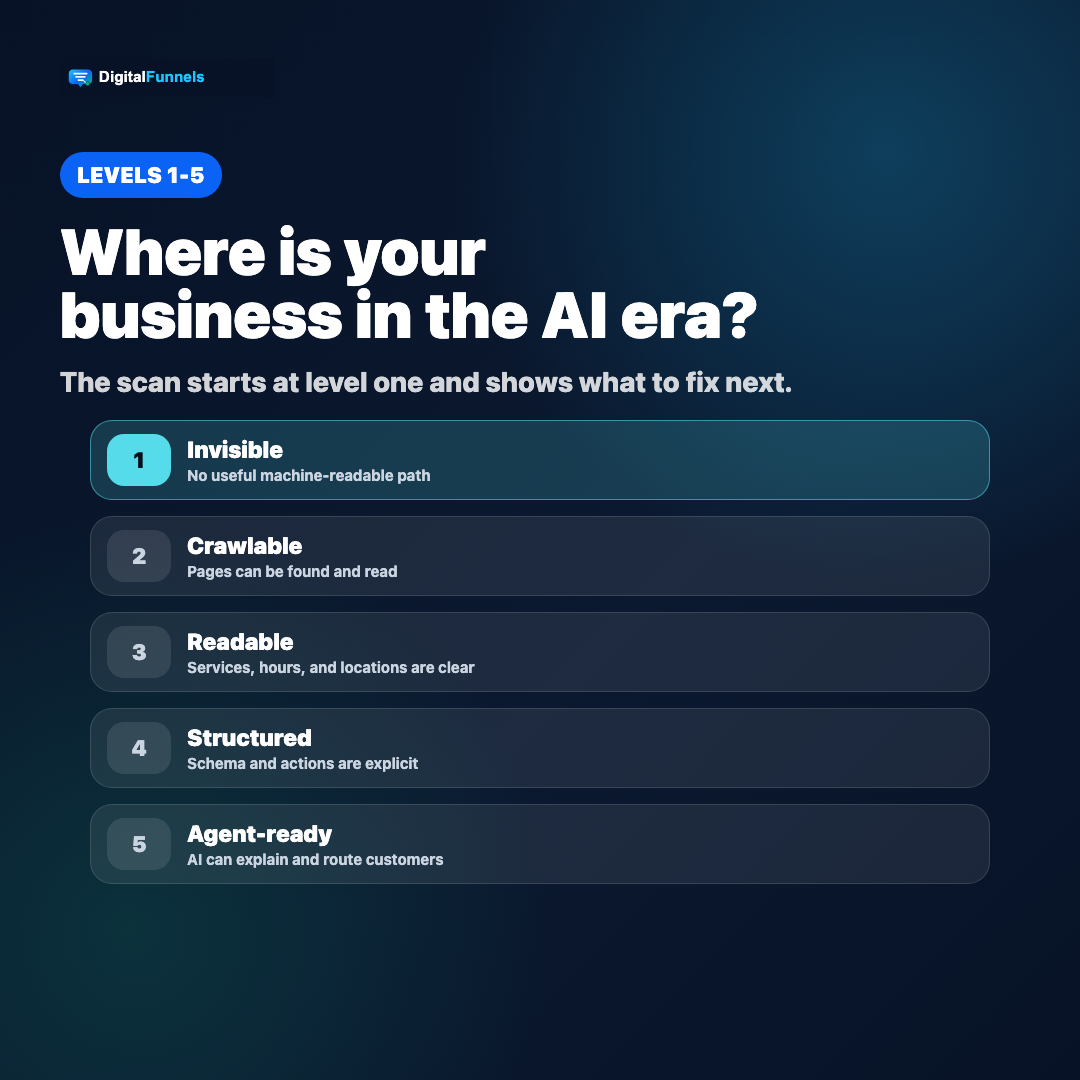
Use four layers:
1. Search eligibility
- indexed priority pages;
- crawl errors;
- valid canonical URLs;
- structured-data errors;
- sitemap coverage.
2. Traditional search demand
- impressions and clicks in Search Console;
- non-brand and brand query groups;
- local landing-page engagement;
- calls, forms and bookings.
3. Local profile interactions
Google Business Profile performance can report calls, website clicks, directions and other applicable interactions. Track these against a consistent baseline.
4. AI citations
When available, use Bing AI Performance to monitor cited pages, citation trends and sampled grounding queries. Treat this as one visibility signal, not a revenue metric.
For Google AI features, report Search Console and analytics trends with the caveat that current Search Console Web reporting does not isolate all AI-feature activity into a separate citation view.
A 30-day operating plan
Week 1: establish truth
- create the canonical business-facts sheet;
- audit Google Business Profile and Bing Places;
- verify phone, hours, services and service areas;
- identify conflicting listings.
Week 2: fix retrieval
- verify Search Console and Bing Webmaster Tools;
- repair indexing, canonical and sitemap issues;
- validate LocalBusiness or Organization markup;
- make priority pages reachable through internal links.
Week 3: improve answers
- rewrite the top three service pages around customer questions;
- add first-hand process detail;
- add descriptive photos and captions;
- publish one genuinely useful guide.
Week 4: measure and prioritize
- export the baseline metrics;
- review cited pages and grounding queries where Bing AI Performance is available;
- compare profile interactions;
- choose the next three content or data gaps;
- assign owners and review dates.
The correct cadence is test, observe, improve. Do not build an expensive AI-visibility program before you can explain what will be measured.
Digital Funnels combines a Free Business Scan, a managed local visibility system, and AI-era optimization to identify the first gaps and assign the work. The system can use different models for different tasks, but model choice is not a substitute for accurate business data, useful content and human review.